He folded punched sheet steel as if it were cloth, gave the technique a name in 1952, and then left furniture entirely for tapestry.
Perforated sheet metal was a workshop material: guards, screens, ventilation panels. Matégot is the reason it turns up in the Musee des Arts Decoratifs and the Centre Pompidou.
Budapest, Paris, and a machine
Matégot was born on 4 April 1910 at Tapio-Sully in Hungary and died in Angers in February 2001. He travelled in Italy and the United States before settling in France in 1931, worked on sets for the Folies Bergere, and from 1933 began making rattan furniture on metal frames. After the war he opened a workshop that used metal, rattan, glass, formica and perforated sheet in the same pieces.
The perforated sheet is what the name is attached to. He punched the metal first with cloverleaf patterns and later with small squares and rounds, then folded, pleated and shaped it on machinery he developed for the purpose. In 1952 he named the resulting openwork mesh Rigitulle. The Nagasaki chair of 1954 and the Copacabana armchair of 1955 are the canonical pieces, both in steel tube and perforated sheet, and both now in French national collections. In the early 1960s he stopped designing furniture and worked on tapestry for the rest of his career.
The material carries load and light at the same time. That is the whole idea, and almost nobody else got it to work.
What the shelves in this sale show
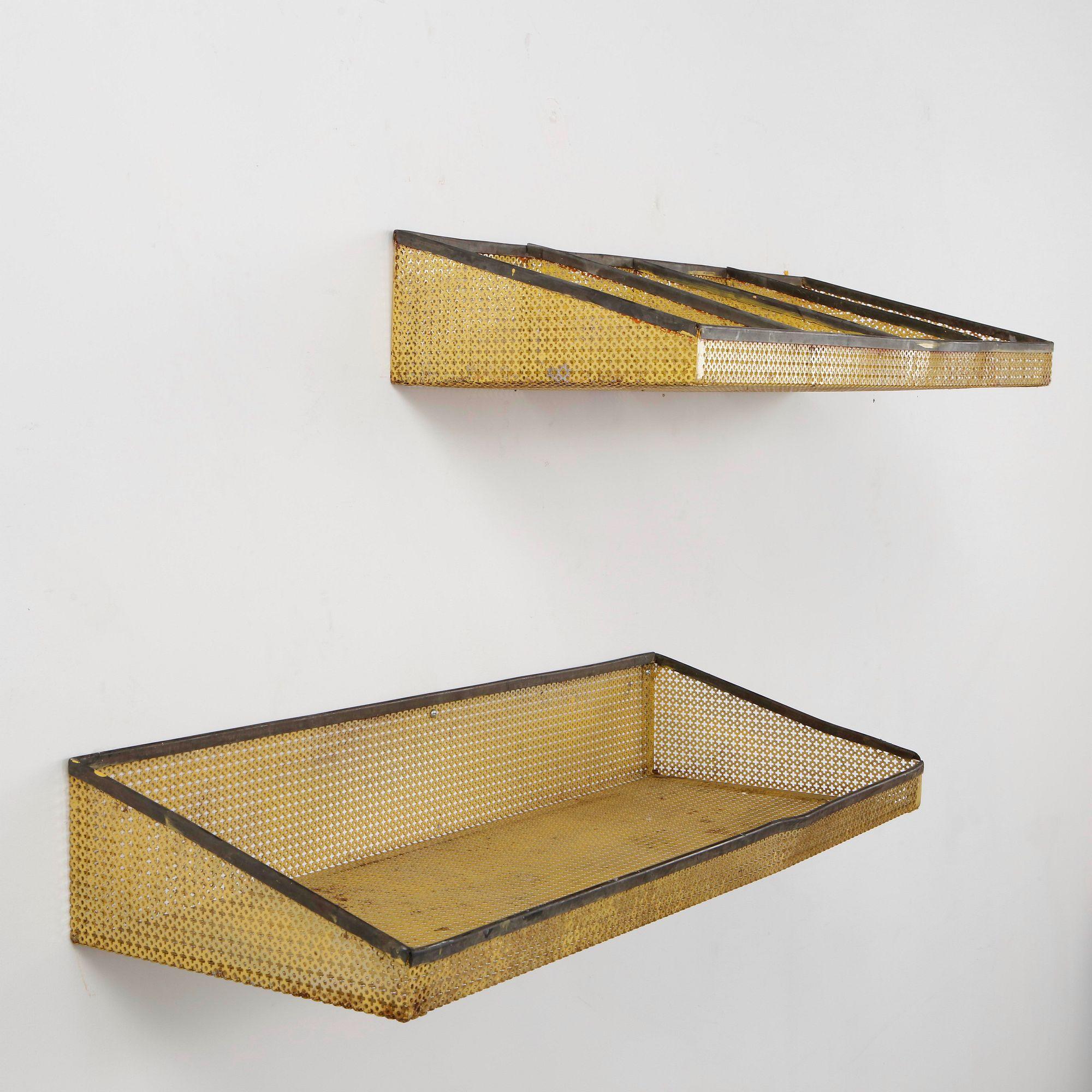
Lots 62 and 63 are two pairs of wall-mounted shelves in perforated sheet, one pair in yellow and one in the more usual dark finish, both 37 inches long and 6 inches high. They are a good demonstration of why the technique mattered. A shelf that long in solid sheet would need a bracket; the folded perforated edge is the bracket. The mesh also means the shelf casts a pattern instead of a shadow, which is why these read as light objects on a wall rather than as storage.
Matégot and in the style of Matégot
Because the vocabulary was so widely copied through the 1950s and 1960s, Circa catalogs unattributed pieces plainly. Lot 184 is a perforated metal umbrella stand described as in his style and estimated at $400 to $600. Lot 264 is a wrought iron outdoor dining set also described as in his style, which is a looser comparison still: scrolling openwork iron shares the visual openness but none of the folded-sheet technique.
The reference point is the last comparable Circa result. In Modernism + Design on 8 August 2026 a documented Matégot perforated black metal magazine rack estimated at $1,000 to $1,500 sold for $500, while an umbrella stand in his style at the same sale went unsold. The attributed pieces move; the derivative ones need the right room and the right price.
Condition, honestly
The failure points are consistent. Check the perforated field for dents, because a folded sheet cannot be planished flat again. Check the fold lines for hairline splits. Original paint is preferred and repainting is common; a thick, even, modern finish that has filled the perforations at the edges is a repaint. All of these are visible in strong raking light, which is how to look at these lots during preview at Mission Road.