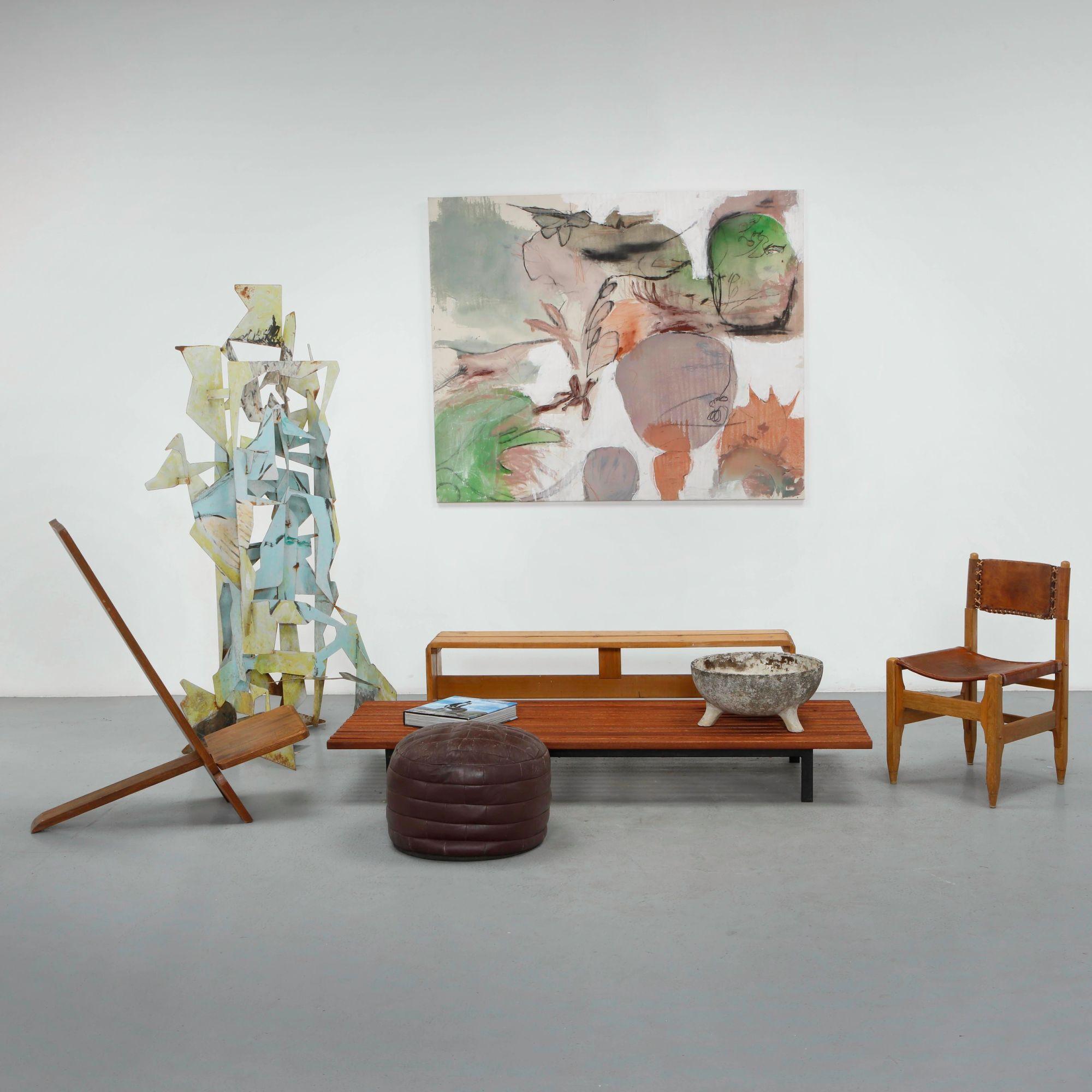
Capron did not decorate furniture with tiles. He built furniture out of a tile industry, in a Vallauris factory that at its peak employed 120 people.
Most designers who used ceramic tile treated it as a surface applied at the end. Capron worked the other way round. He ran a tile factory, and the furniture came out of what the factory could already make.
Vallauris, twice
Capron was born in Vincennes in 1922 and studied at the Ecole des Arts Appliques a l'Industrie in Paris between 1939 and 1943. In 1946 he moved to Vallauris, the pottery town above Cannes, and founded a workshop called l'Atelier Callis with Robert Picault and Jean Derval. That is the first Vallauris: small, handmade, artisanal.
The second one starts in 1952, when he bought an abandoned pottery in the same town and opened a factory with fifteen workers. By 1980 it employed 120. The awards followed the industrial phase rather than the studio one: a gold medal at the Milan Triennale in 1954, a silver at Cannes in 1955, gold medals at the Brussels exhibition in 1957 and 1958 specifically for architectural ceramics, and the Grand Prix International de la Ceramique in 1970. The factory closed in 1982.
The Brussels medals were for architectural ceramics. That is the correct frame for the furniture as well.
Why the tables work
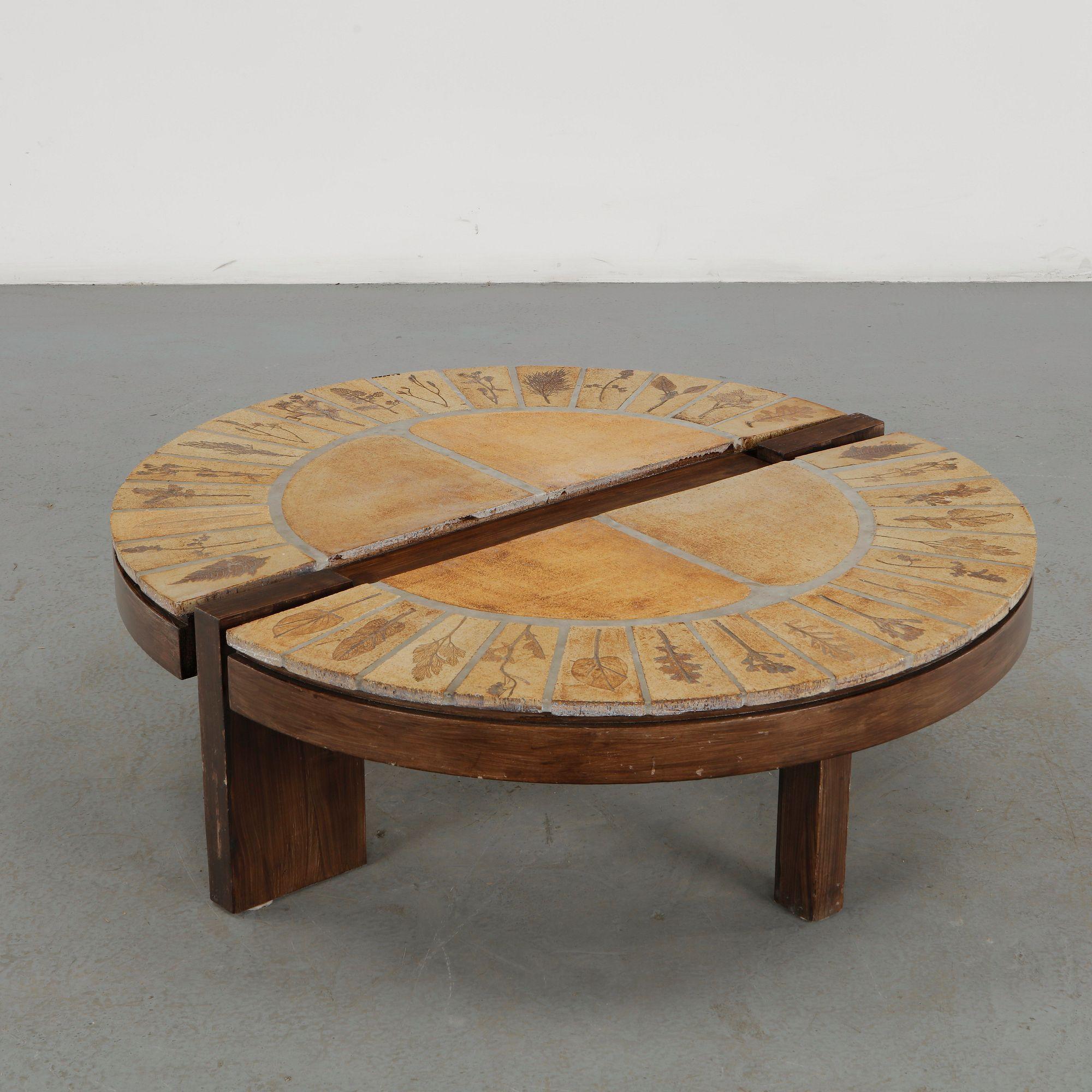
A Capron table top is a field of individually made tiles set into a wooden carcass. Because the tiles were production items, they carry the same glazes and the same incised botanical and geometric motifs that went into walls and floors. Because they were set by hand into a frame, no two tops repeat.
The practical consequence is that a Capron table is the most forgiving surface in a modern house. Glazed ceramic does not mark from a wet glass, does not fade in direct sun and does not scorch. The failure mode is different: a chipped tile edge or a cracked grout line, both of which are visible in photographs and both of which are worth asking about in a condition request.
Signed, unsigned and in the style of
Vallauris produced an enormous quantity of ceramic-topped furniture in the 1960s and 1970s, much of it by workshops that were following Capron rather than working with him. Lot 342 in this sale is catalogued honestly as a brutalist ceramic coffee table in his style, and it is estimated at $1,200 to $1,800 against $2,000 to $3,000 for the documented round table at lot 67. That gap is the attribution, and it is the same gap Circa saw on 29 August 2026, when a Capron Planet table made $1,400 and a Herbarium table made $1,500.
What separates them in the hand rather than in the catalog is the tile itself. Capron's glazes sit deep and slightly uneven, the incised lines are cut rather than printed, and the tiles are laid to a plan that follows the shape of the top. Copies tend to use a uniform commercial tile and a rectangular grid inside a curved frame. Both tables in this sale can be examined at Mission Road during preview.