Sourcing six matching chairs takes months. Buying them as one lot takes one bid. Why the trade watches the multiples first.
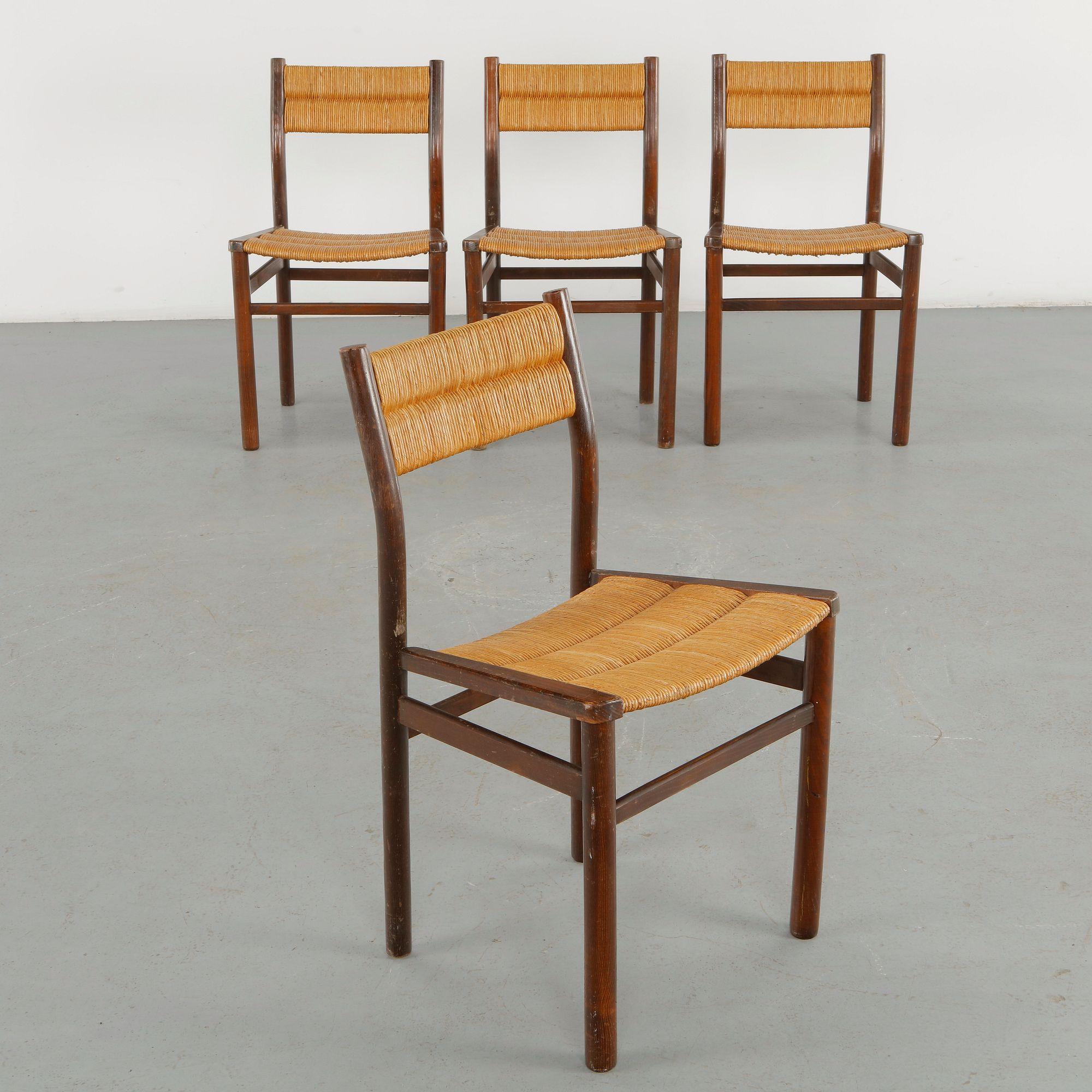
Ask any designer who sources vintage what the hardest part of the job is and the answer is rarely finding a good chair. It is finding six of them, in the same wood, with the same wear, that were made at the same time. At auction that problem is solved by the cataloguer rather than by you.
Why multiples are undervalued
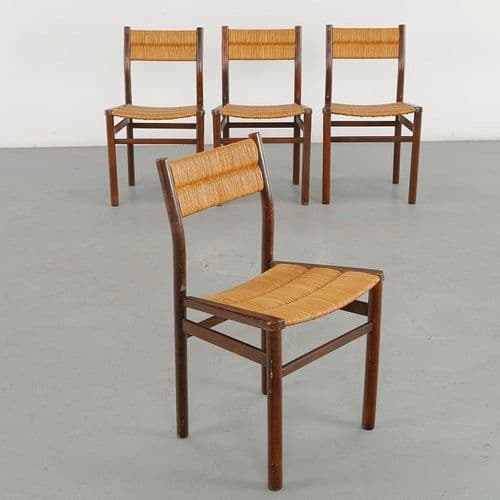
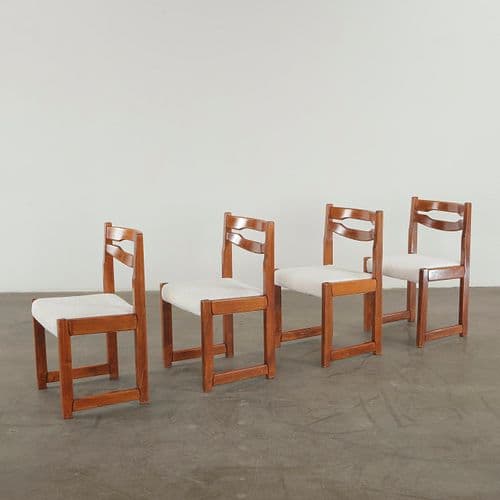
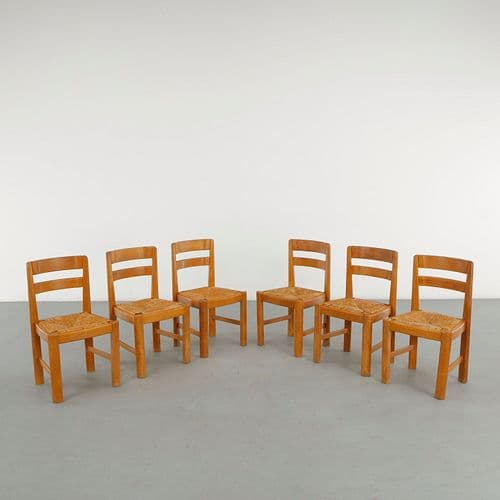
A set of six chairs is one lot with one estimate, and estimates on sets are usually built from a per-chair figure that assumes some discount for volume. Lot 109, a set of six Maison Regain rope and wood chairs, is estimated at $2,400 to $3,600, which is $400 to $600 a chair for documented French production. Lot 68, a set of four Niels Otto Moller Model 78 dining chairs for J.L. Mollers Mobelfabrik, is estimated at $1,200 to $1,800, which is $300 to $450 a chair for Danish cabinetmaking of the period.
The reason for the discount is that fewer buyers can absorb six chairs. Very few private bidders need six. Almost every trade buyer does.
A set at auction is priced against the number of people who want all of it, not against the number of people who want one.
The multiples in this sale
- Lot 103, Pierre Gauthier-Delaye, set of four Weekend chairs. Undulating ladder backs and woven rope seats, a 17.5-inch seat height that works with almost any period table.
- Lot 109, Maison Regain, set of six rope and wood chairs. The most usable dining set of the group and the one with the broadest table tolerance.
- Lot 68, Niels Otto Moller for J.L. Mollers Mobelfabrik, set of four Model 78 dining chairs with rush seats.
- Lot 310, Olavi Hanninen, set of three elm stools. Odd numbers are their own opportunity; three stools at a counter is a complete answer.
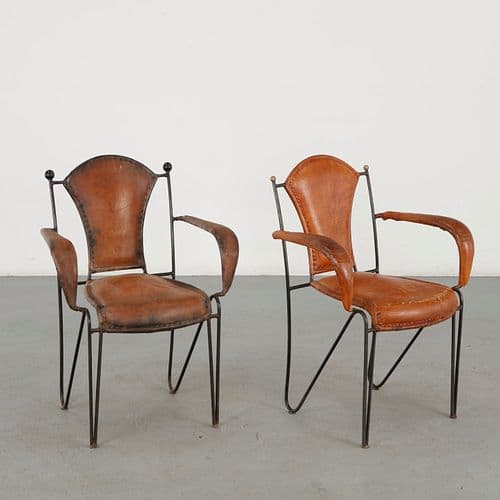
- Lot 227, Jacques Adnet, pair of iron and leather armchairs. A matched pair of documented Adnet is scarcer than a set of six anonymous chairs.
- Lot 62, Mathieu Matégot, pair of perforated metal wall shelves in yellow. A pair of shelves is a wall composition; a single shelf is a shelf.
- Lot 212, pair of tall conical cast concrete planters. Symmetry is the whole reason to buy garden planters in twos.
- Lot 8, Willy Guhl, pair of monumental square planters at 31.5 inches square. The largest matched Guhl pair in the sale.
What to check on a set
- Consistency of wear. Chairs that lived together age together. A set where one chair is visibly brighter has had a replacement introduced.
- Seat construction. Rush and rope seats are consumable and are re-wrapped routinely. Ask whether any in the set have been redone, because a mixed set will read unevenly.
- Frame stability. On a set of six, expect at least one to need re-gluing. Price it in rather than being surprised.
- Stack and store. Sets are bought for eight and used for four. Confirm the pieces fit through your storage door.
Splitting and combining
Two habits are worth having. The first is buying a set larger than you need and using the surplus at a desk, in a bedroom or on a landing, which is cheaper than buying those chairs separately and gives a house continuity. The second is buying a pair specifically as a pair: two armchairs facing, two planters flanking, two shelves on one wall. Symmetry is a shortcut to resolution in a room and it cannot be assembled later from singles.
Every set in this sale can be examined at Mission Road during preview, which is the only way to check consistency of wear across six chairs.